How to Choose a Covering for a Concrete Patio
For most patios, a low-pile outdoor rug is the fastest covering for concrete patio use: it adds comfort and color in one afternoon, costs less than tiles or coatings, and can be lifted for cleaning. Choose interlocking tiles for a firmer permanent feel, or a concrete coating if the bare slab itself needs a new finish.
On this page (14 sections)
- What covering for concrete patio fits your use best?
- How do outdoor rugs compare as a patio covering?
- Which rug size works for a concrete patio?
- What do interlocking deck tiles add over a rug?
- When is a concrete coating the better choice?
- How does the best flooring for outdoor patio compare?
- What are inexpensive concrete patio coverings?
- How do you keep a covering clean on concrete?
- How does sun and rain change your pick?
- Which pattern and color hide patio wear best?
- How do you secure furniture on a covered patio?
- Which of these rugs suits which patio?
- What should you check before you buy a covering?
- How should you decide between a rug, tiles and a coating?
For most patios, a low-pile outdoor rug is the fastest covering for concrete patio use. It adds comfort and color in one afternoon, costs less than tiles or coatings, and can be lifted for cleaning.
Choose interlocking tiles for a firmer permanent feel, or a concrete coating if the bare slab itself needs a new finish. We compared covering types by installation, upkeep and practical use.
What covering for concrete patio fits your use best?
The best covering for concrete patio use depends on how you sit, eat and walk there. A dining area needs a flat covering that chairs can slide on.
A lounge area can use a softer rug under feet.
A door area needs a small mat that catches dirt. A wide open slab may need tiles or a coating rather than a single rug.
Start with the use, not the pattern. Measure the clear space under furniture.
Keep 12 to 18 inches of bare slab around edges.
If the slab has cracks, lifting or stains, fix the base first. Our guide on how to fix cracks in concrete patio helps you judge what needs repair.
Rule: pick a rug for comfort and quick change, tiles for a firm fixed feel, and a coating for a new slab finish.
How do outdoor rugs compare as a patio covering?
Outdoor rugs are the easiest covering for concrete patio spaces because they need no tools. You unroll them, smooth the corners and set furniture on top.
Most low-pile synthetic rugs rinse with a hose.
Rugs add color and define a seating zone on a plain slab. They soften sound and make concrete less harsh under bare feet.
The trade-off is upkeep, as dirt and water can collect under the rug.
Polypropylene rugs resist fading better than cotton in sun. Low pile traps less dirt.
Flat weave holds less water than thick pile.
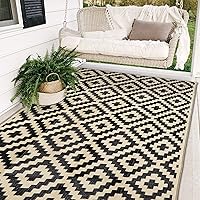
This JONATHAN Y Moroccan rug is 120 by 93 inches, low pile and flat weave of 100 percent polypropylene. It suits a seating area where feet and chair legs move often.
It has no backing, so it can shift on smooth concrete in wind. JONATHAN Y suggests a rug pad, which can help where the slab stays clean and dry.
Rule: choose a low-pile synthetic rug when you want softness, color and easy removal.
Which rug size works for a concrete patio?
Size your covering around the furniture footprint, not the whole slab. A rug should extend at least 6 inches past front chair legs.
For a sofa set, front legs should usually sit on the rug.
The two JONATHAN Y rugs here are each 120 by 93 inches. That size fits a sofa, two chairs and a coffee table in many layouts.
It will look small on a very large open patio.
Measure sofa width and add space for side chairs. Then measure depth from sofa front to chair legs.
Buy larger if measurements run close to a border.
Large rugs for seating zones
An 8x10 rug works when the seating group is compact. It can anchor a sofa and two chairs without covering the full slab.
Bare concrete around the edge makes hosing easier.
It also works under a dining table with four chairs if the table is modest. Test chair placement before you commit, as chairs may slip off the edge when pulled out.
Small mats for doors and layering
The SEEKSEE mat is 43 by 27 inches, low profile and cotton. It fits in front of a door or under a coir doormat.
It will not anchor a sofa group.
Rule: buy size for the furniture group, and keep uncovered slab around the edge.
What do interlocking deck tiles add over a rug?
Interlocking deck tiles give a firmer, more even feel than a rug on concrete. Each tile locks to the next, so the surface does not bunch or shift.
They drain faster than a rug in rain.
Tiles can cover a large slab in a grid. You can lift one tile for cleaning or replace a worn tile without redoing the floor.
Cost per square foot is higher than most rugs.
Tiles need a level, clean slab. Grit under a tile can make it rock.
A rug hides small slab marks better than tiles.
Our guide to interlocking deck tiles covers fit, drainage and layout. Read it if you want a fixed surface rather than a soft one.
Tiles suit areas where chairs move a lot. A rug can fold under chair legs, while tiles stay in place.
Tiles are less soft underfoot than a rug with a pad.
Rule: choose tiles when you want a firm, fixed surface and can prep a clean, level slab.
When is a concrete coating the better choice?
A concrete coating is the better choice when the slab finish itself is the problem. Coatings can cover stains, dull color and light wear in one solid surface.
They also make the slab easier to sweep and rinse.
A coating is not a soft covering. It will not add the cushion of a rug or the grip pattern of tiles.
It takes prep, drying time and more skill than unrolling a rug.
If your slab is sound and you mainly want comfort, a rug is faster. If the slab looks tired when clean, a coating may do more.
Our guide to the best concrete coating for outdoor patio walks through types and prep.
Coatings cost more than rugs and often more than tiles, depending on size and prep. Rugs can be changed with season, while a coating is a longer commitment.
Rule: choose a coating to renew the slab, not to add softness.
How does the best flooring for outdoor patio compare?
The best flooring for outdoor patio depends on whether you want a surface that moves or one that stays. Rugs and mats can be lifted, washed and swapped.
Tiles and coatings stay fixed.
A fixed floor suits a patio you use daily and never plan to change. A rug suits a patio where you rent, test a style or want seasonal change.
It also suits a slab that is not perfectly level.
Think about drainage next. Concrete sheds water to edges, but a rug can trap moisture if it stays wet.
Lift the rug after heavy rain and let the slab dry.
Tiles allow water to pass between joints. Coatings seal the slab, so water runs off the top.
Each choice changes how you clean after storms.
Rule: choose a removable covering for flexibility, and a fixed floor for a long-term finish.
What are inexpensive concrete patio coverings?
Inexpensive concrete patio coverings include outdoor rugs, washable mats and modular tiles. Rugs give the most coverage per dollar.
Mats cost less and suit small zones.
Foam mats are another low-cost option, but they can tear and fade faster outdoors. Interlocking tiles cost more upfront but can last with less care.
Compare total cost for the area you need to cover.
A large rug can cover a seating zone for less than tiling the same area. Two smaller rugs can also work if furniture is split into two groups.
That split can cost less than one oversize rug.
Care affects long-term cost too. A rug you rinse monthly will last longer than one left with damp grit.
The SEEKSEE mat adds texture at a door for low cost. It is washable and reversible, but cotton needs prompt drying.
Rule: for low cost, cover only the use zone with a rug or mat, not the full slab.
How do you keep a covering clean on concrete?
Clean your covering on a schedule, not when it looks dirty. Sweep or shake a rug weekly in dry weather.
Rinse it with a hose when grit builds up.
For the two JONATHAN Y rugs, JONATHAN Y gives a simple wash method. Spray the surface with a 5 to 1 mix of mild dish soap and water.
Rinse well with a hose and hang over a railing to dry fully.
The SEEKSEE mat can go in the washing machine on a gentle cycle. Tumble dry on low.
That care suits a small mat better than a large 8x10 rug.
Concrete needs care too. Sweep the slab before you put a rug back down.
Grit left on concrete can grind into fibers and dull the back.
Remove spills fast. Blot liquid with a clean cloth rather than rubbing it across the rug.
For the JONATHAN Y rugs, blot firmly around a spill and use a brushless vacuum.
Rule: lift, sweep the slab, rinse the covering, and dry it fully before you reset it.
How does sun and rain change your pick?
Sun and rain should narrow your choice fast. Polypropylene rugs handle sun and moisture better than cotton covers.
The JONATHAN Y rugs use polypropylene and resist UV fading, according to JONATHAN Y.
Cotton mats can fade and stay damp longer. The SEEKSEE mat is cotton, so SEEKSEE advises avoiding prolonged rain exposure.
It suits a covered porch more than a full sun open patio.
JONATHAN Y also advises avoiding direct and continuous exposure to sunlight for its rugs. Rotate the rug through the season so one area does not fade faster.
Rain patterns matter as well. A rug under a roof edge will dry faster than one in the open.
If water pools on your slab, choose a covering you can lift after each storm. Furniture legs or a pad can help hold light rugs in wind.
Rule: for full sun and frequent rain, pick polypropylene or tiles and plan to lift and dry them.
Which pattern and color hide patio wear best?
Pattern can hide dirt, but it cannot fix a worn slab. A busy geometric or floral pattern hides small marks better than a solid color.
It also sets a style for the seating zone.
The JONATHAN Y Moroccan rug uses khaki, beige and black in a geometric pattern. Mingled texture and dark lines can mask light grit between cleanings.
It suits a neutral patio with wood or metal furniture.
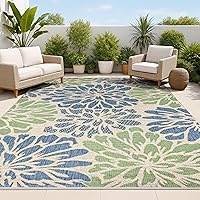
The JONATHAN Y floral rug uses navy, green and beige in a large floral pattern. It adds color to a plain slab and suits a modern look.
Large patterns can show wear if the rug shifts or folds often.
The SEEKSEE plaid uses black and white in a buffalo check. It gives a farmhouse look and works in a layered entry.
Plaid shows lint and light dirt more, so it needs more frequent shaking.
Dark patterns hide dirt but can look hot in full sun. Light grounds look fresh but show stains faster.
Rule: pick a mid-tone busy pattern to hide grit, and match the style to your furniture.
How do you secure furniture on a covered patio?
A covering can change how furniture sits. Test chair legs on the covering before you load the patio with decor.
A rug can let chairs slide, while tiles give a firmer base.
Heavy furniture can dent a soft rug over time. Rotate the rug so the same legs do not press one spot all season.
Use leg caps or pads where chairs move often.
If you plan to anchor chairs or a table, see how to secure patio furniture to concrete. Anchors may go through a rug or tiles, so plan layout before you drill.
When you choose furniture, our guide on how to choose outdoor patio furniture helps you match size and material to your space. Umbrellas and side tables need level footing too.
Smooth the rug and set furniture only after the covering is flat.
Rule: set furniture on the covering, test for slide and wobble, then anchor only if the base is stable.
Which of these rugs suits which patio?
The JONATHAN Y Moroccan rug suits a large seating zone that needs a neutral geometric pattern. It is 8x10, low pile, flat weave and polypropylene.
That mix suits high traffic and easy rinsing.
The JONATHAN Y floral rug suits a seating zone where you want color and a modern floral look. It is also 8x10, low pile, flat weave and polypropylene.
The navy and green pattern gives more contrast than the Moroccan rug.
The SEEKSEE plaid mat suits a door, entry or layered porch spot, not a full seating group. It is 43 by 27 inches, low profile and cotton.
It is washable and reversible, but it needs prompt drying.
If your patio is large and open, none of these will cover it alone. Use one rug for the seating zone and leave the rest as bare concrete.
Rule: use an 8x10 rug for a seating group and a small mat for a door, and do not force one piece to cover a huge slab.
What should you check before you buy a covering?
Check five things before you buy: size, material, pile height, care method and wind movement. Size must fit your furniture group with room to spare.
Material tells you how it handles sun and water.
Low pile is best for outdoor traffic because it traps less dirt. Flat weave dries faster than thick pile.
Polypropylene suits sun and spills, while cotton suits covered or light use areas.
Care method matters for large rugs. The SEEKSEE mat is machine washable, while the 8x10 JONATHAN Y rugs are rinsed with a hose and hung to dry.
Check that your machine can handle a large piece before you buy.
Check weight and backing too. The JONATHAN Y rugs have no backing and weigh about 3 kg each in 8x10 size.
The SEEKSEE mat has a cotton back and weighs 1.9 pounds. No backing means the rug can shift on smooth concrete.
Measure door swings and furniture paths. A rug edge should not catch on a door or trip a foot path.
Leave a clear walkway from the house to the seating zone.
Rule: buy only when the size fits the furniture, the material fits the sun and rain, and the care method fits your routine.
How should you decide between a rug, tiles and a coating?
Use this decision rule at the end. **Pick a rug if you want softness, color and quick change.
Pick tiles if you want a firm fixed floor.
Pick a coating if the slab itself needs a new finish.** A rug over a sound slab is the fastest start for most homes.
For a seating zone, the JONATHAN Y Moroccan rug gives a neutral look, while the floral rug gives more color. For a door or layered entry, the SEEKSEE plaid mat gives a washable, reversible option.
If the slab has cracks or lifting, repair it first with our guide on how to fix cracks in concrete patio. If the slab is sound but dull, read the best concrete coating for outdoor patio guide next.
Next, measure your furniture footprint and check sun and rain on that spot. Then choose the covering that fits both the use and the weather.
Your covering for concrete patio should make the space easier to sit in, clean and change, not harder to care for.
Frequently asked questions
What is the best concrete covering for patio use?
For most homes, a low-pile outdoor rug is the best concrete covering for patio use because it is fast, affordable and easy to remove for cleaning. The JONATHAN Y Moroccan 8x10 rug suits large seating areas, while the smaller SEEKSEE plaid mat suits a door area.
Choose tiles or coatings for a more fixed surface.
What are inexpensive concrete patio coverings?
Inexpensive concrete patio coverings include outdoor rugs, washable door mats and foam or interlocking tiles bought in sets. Rugs cost less per square foot and need no tools.
Tiles cost more but give a firmer feel.
Compare size, material and care needs before you buy.
Can I put a rug on a concrete patio?
Yes, if you choose a rug made for indoor and outdoor use and keep it clean and dry. Low-pile synthetic rugs handle foot traffic and rinse with a hose.
Lift the rug after rain so water does not sit on the slab.
A pad can help in high traffic spots.
Is a coating better than a rug for a concrete patio?
A coating is better when the slab has wear, stains or a dull finish you want to change at the surface. A rug is better when you want softness, color and an easy change without tools.
Many patios use both, with a rug over a sound coated or bare slab.