6 Best Patio Screen Enclosures (November 2026)
The best patio screen enclosures include the Kozyard 50" W x 48" H Outdoor for equipment privacy, the FLAGLY 10x10 ft Mosquito Netting for Pop for canopy bug protection, and the OceanTailer HomeRoots 9' Patio Umbrella Outdoor Table for umbrella dining.
On this page (3 sections)
The best patio screen enclosures depend on the job. Some hide equipment from view, while others keep flying insects away from people eating or sitting outside.
Kozyard is the top choice for hiding patio equipment. FLAGLY is better for enclosing a 10 x 10 ft canopy against insects, and OceanTailer fits outdoor dining beneath an umbrella.
These are different tools for different patios. A solid panel screen will not keep mosquitoes out, and a mesh canopy will not hide a trash can or air conditioner in the same way.
This roundup compares freestanding privacy screens, canopy mesh and umbrella netting. We checked panel sizes, materials, ground supports, layouts and access features so you can match the enclosure to your patio.
Panel size matters more than the label on the box. A wide panel can cover a single unit quickly, while several smaller panels can follow a corner or wrap around a wider area.
Ground support also changes the choice. Stakes suit soil and grass, foot plates suit a patio slab, and mesh systems depend on a canopy or umbrella already in place.
Access is another practical point. Zipper doors work well for a seating area people enter often, while a fixed panel is simpler when the goal is only to block a view.
Care needs differ by material as well. Smooth HDPE and PVC panels can be rinsed, powder-coated steel can be wiped clean, and fabric mesh should be dried before folding.
If you want a broader look at screens, see our guide to best outdoor patio screens. That guide can help you place these options next to other outdoor privacy ideas.
For a softer privacy layer, compare outdoor curtains with freestanding panels. Curtains suit covered areas, while panels suit open patios and side yards.
Use this roundup to narrow the field by job first. Once you know whether you need privacy, airflow, insect protection or a mix, the right size and support method become easier to judge.
Our picks at a glance
-
1

-
2
 Best for canopy bug protection
FLAGLY 10x10 ft Mosquito Netting for Pop
9.5/10 our score
See it on Amazon -
3
 Best for umbrella dining
OceanTailer HomeRoots 9' Patio Umbrella Outdoor Table
9.3/10 our score
See it on Amazon
- 4
 Check it
VEVOR 2 Panels Outdoor Privacy Screen
Best for anchored vinyl screening - 5
 Check it
Wanfu Metal Air Conditioner Fence
Best for metal panel strength - 6
 Best for flexible four-panel layoutsCheck it
The best patio screen enclosures for different uses
The best patio screen enclosure is the one that matches your space. A screen that is too short, too narrow or fixed to the wrong kind of ground will frustrate you long after the first week.
If you also want adjustable overhead shade, compare retractable patio awnings. Shade on its own will not screen equipment or stop insects, but it can work beside a different type of screen.
Use a privacy fence for equipment, mesh for insect control and an umbrella enclosure for compact dining areas. Keeping those jobs separate makes each product easier to judge.
Privacy panels are for items that stay in one place. Trash cans, air conditioners, pool equipment and garden tools do not need a zipper door, and they do need room for air to move around them.
Mesh enclosures are for people. Their value comes from how easy it is to get seated, pass food, talk and leave without lifting or pushing the netting.
An umbrella enclosure suits a smaller dining setup best. It suits a table and chairs under one umbrella, not a large gathering spread across a canopy frame.
Our score weighs specs, features and buyer feedback against what you're shopping for. It should not replace measurements, because a highly rated screen still fails if it is the wrong height or layout.
Measure the item or shelter first, then check the support method. If the screen needs stakes, confirm that the ground is soft enough, and if it needs foot plates, confirm that the surface is flat and firm.
Leave access for cleaning and service as well. A screen that hides an air conditioner should still leave space for airflow and for anyone who needs to reach the unit.
Choose the layout that fits the corner, wall or path beside it. A straight line, an L shape and a U shape each hide a different amount, and the right shape depends on where neighbours and guests can see.
| Product | Best for | Panel size | Materials | Panel count | Our score |
|---|---|---|---|---|---|
| Kozyard 50" W x 48" H Outdoor | equipment privacy | 50 in W x 48 in H | Aluminum posts and HDPE panels | 2 | 9.7 |
| FLAGLY 10x10 ft Mosquito Netting for Pop | canopy bug protection | 9.5 | |||
| OceanTailer HomeRoots 9' Patio Umbrella Outdoor Table | umbrella dining | 9.3 | |||
| VEVOR 2 Panels Outdoor Privacy Screen | anchored vinyl screening | 48 x 48 in | 9.1 | ||
| Wanfu Metal Air Conditioner Fence | metal panel strength | 3 | 8.8 | ||
| ADDOK Outdoor Privacy Screen | flexible four-panel layouts | 4 | 8.6 |
1. Kozyard 50" W x 48" H Outdoor: Best for equipment privacy
Kozyard 50" W x 48" H Outdoor: Best for equipment privacy
- 50 x 48 x 50 in fence set
- 2 HDPE panels
- Aluminum posts
- 3/16 in ventilation gaps
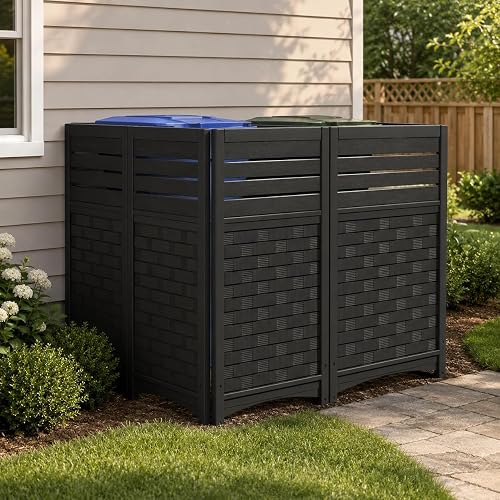
A 2-panel screen for hiding air conditioners, trash cans, pool equipment and other patio clutter while keeping ventilation gaps between the slats.
Pros
- Aluminum posts
- HDPE panels
- Soft-ground stakes
- Dual-sided slat design
Cons
- Designed for visual screening, not a full room enclosure
Kozyard is the strongest match for hiding a utility item beside a patio. Its set measures 50 x 48 x 50 in and includes 2 HDPE panels with aluminum posts.
The 3/16 in gaps between the boards help preserve airflow while reducing the view of trash cans, air conditioners, leaf piles and garden tools. That makes it more suitable for a screened utility area than a solid panel with no ventilation.
For soft ground, the 11 in galvanized steel stakes insert into soil. The 6 in foot plates can also be secured with compatible ground anchors or hard-surface fasteners when the screen sits on a firmer base.
The dual-sided slats give you a choice between a wide-slat and narrow-slat appearance. Hardware and instructions are included for assembly, but measure around the item first so the 50 in width and depth provide enough coverage.
Choose Kozyard when the main goal is cleaner-looking equipment storage with ventilation. It is not a full insect enclosure for patio seating.
2. FLAGLY 10x10 ft Mosquito Netting for Pop: Best for canopy bug protection
FLAGLY 10x10 ft Mosquito Netting for Pop: Best for canopy bug protection
- Fits a 10 x 10 ft pop-up canopy
- Breathable black mesh
- Zipper doors
- Extra attachment straps
A canopy enclosure for meals, gatherings and camping when you want airflow and visibility with protection from flying insects.
Pros
- Zippered access
- Breathable mesh
- Extra attachment straps
Cons
- Netting only
- Not water resistant
FLAGLY is the best fit for a 10 x 10 ft pop-up canopy that needs insect screening. The black fabric mesh creates a fully enclosed area with zipper doors, so guests can enter without lifting the netting.
Extra attachment straps help keep the netting secured to the canopy. The breathable mesh preserves airflow and visibility, which is useful for patio meals, camping and backyard gatherings.
This is netting only, so you need a compatible 10 x 10 ft pop-up canopy. The material is not water resistant and has no ultraviolet light protection, so it should not be treated as a rain cover or sun-blocking wall.
The 3.4 lb netting is easier to store than a rigid enclosure. Before setting it up, confirm that your canopy frame matches the stated 10 x 10 ft size and that the zipper doors open toward a convenient walkway.
Choose FLAGLY when mosquitoes are the main problem and you already have a 10 x 10 ft canopy. For a fixed privacy barrier, choose one of the panel systems below.
3. OceanTailer HomeRoots 9' Patio Umbrella Outdoor Table: Best for umbrella dining
OceanTailer HomeRoots 9' Patio Umbrella Outdoor Table: Best for umbrella dining
- Fits umbrellas up to 9 ft
- 100% polyester mesh
- Adjustable drawstring top
- Water-fill base tubes
A lightweight umbrella screen that drops around a patio table and uses water-filled base tubes to help hold the enclosure in place.
Pros
- Adjustable top cinch
- Folds for storage
- Keeps outdoor views open
Cons
- Umbrella, table, stand and chairs are not included
OceanTailer fits a different patio layout: a table and chairs beneath an umbrella. The black enclosure uses 100% polyester mesh and adjusts around umbrellas up to 9 ft in diameter.
A drawstring at the top creates a flexible fit around the umbrella. The lower tubes can be filled with water to help keep the screen in place, while the lightweight material folds for storage when outdoor dining is finished.
The screen is designed to preserve the view rather than create a solid wall. It is also a cover only, so the umbrella, stand, table and chairs shown with it are not included.
Measure your umbrella before ordering, especially if its canopy is close to the 9 ft limit. Keep enough room around the table for the mesh to hang without blocking normal movement.
Choose OceanTailer for compact mosquito protection around an umbrella table. If your seating area is under a pop-up canopy, FLAGLY is the closer match.
4. VEVOR 2 Panels Outdoor Privacy Screen: Best for anchored vinyl screening
VEVOR 2 Panels Outdoor Privacy Screen: Best for anchored vinyl screening
- 2 PVC panels
- 48 x 48 in panels
- 27.6 in galvanized ground stakes
- 90 or 180 degree layouts
A 2-panel PVC enclosure for air conditioners, trash bins and pool equipment, with layouts that can form an L shape or straight line.
Pros
- Long ground stakes
- Waterproof PVC
- Easy-clean surface
- Flexible layout
Cons
- 44.4 lb item weight
VEVOR suits buyers who want a 2-panel privacy barrier made from PVC. Each panel measures 48 x 48 in, making the set useful for hiding trash bins, pool equipment and air conditioners.
The 27.6 in galvanized metal ground stakes are designed for soft soil, gravel and sand. VEVOR recommends inserting at least 20 in for stronger resistance to wind and rain, so check the ground depth before choosing the installation spot.
The panels can form a 90-degree L shape or a 180-degree straight arrangement. The grooved slide-in design uses screws, and additional panels can be added when you need more coverage.
PVC is waterproof, corrosion resistant and rust resistant, with a surface that can be rinsed with water. The set weighs 44.4 lb, so plan the assembly area and have the panels positioned before securing them.
Choose VEVOR when you want long stakes and flexible panel placement. It is a utility screen, not a breathable mosquito enclosure.
5. Wanfu Metal Air Conditioner Fence: Best for metal panel strength
Wanfu Metal Air Conditioner Fence: Best for metal panel strength
- 3 metal panels
- 42 x 38 in dimensions
- Powder-coated steel
- 10.7 in stakes and stabilizing feet
A 3-panel steel screen for air conditioners, trash cans and pool equipment, with stakes for soft ground and stabilizing feet for hard surfaces.
Pros
- 3-panel design
- Powder-coated steel
- Soft- and hard-surface setup
Cons
- Smaller height than the 48 in panels
Wanfu is a 3-panel steel screen for hiding air conditioners, trash cans and pool equipment. Each panel is 42 in high and 38 in wide, so compare those dimensions with the item you want to conceal.
The powder-coated steel has an anti-rust coating and a smooth surface that can be wiped clean. Gaps between the panels help provide ventilation while reducing the view of outdoor equipment.
For soil, sand or lawn, the included 10.7 in metal stakes provide the basic support. On concrete or another hard surface, use the attached stabilizing feet and secure them with screws.
The 3-panel format gives more pieces to arrange around an item than a basic 2-panel screen. It is also shorter than the 48 in options, which may suit a lower visual barrier or a space where a taller screen would feel bulky.
Choose Wanfu when steel construction and soft- or hard-surface setup matter most. Keep adequate clearance around any air conditioner for airflow and service access.
6. ADDOK Outdoor Privacy Screen: Best for flexible four-panel layouts
ADDOK Outdoor Privacy Screen: Best for flexible four-panel layouts
- 4 HDPE panels
- 45 x 22 in panel dimensions
- 8 metal stakes
- Straight, L, U or angled layouts
A 4-panel screen for wider or multi-angle coverage around trash cans, garden supplies, pool equipment and selected utility areas.
Pros
- Four-panel coverage
- Eight metal stakes
- No digging or concrete
- Easy-clean surface
Cons
- Check panel dimensions against the item being screened
ADDOK offers the widest panel count in this group, with 4 HDPE panels and 8 metal stakes. Each panel is 45 in high and 22 in wide, giving you several ways to screen a narrow or irregular area.
You can arrange the panels in a straight line, L shape, U shape or angled layout. That flexibility helps when trash cans, garden supplies or pool equipment sit beside a wall, path or corner.
The stakes insert into soil or grass without digging or concrete. The panels use HDPE, plastic and resin, with a smooth surface that can be wiped or rinsed clean.
Around an air conditioner, leave enough space for ventilation and maintenance access. A screen that blocks the view should not prevent the unit from moving air or a technician from reaching it.
Choose ADDOK when four smaller panels fit your layout better than two wider panels. Measure the equipment and the available ground before buying because each panel is only 22 in wide.
How should you compare patio screen enclosures?
Compare the enclosure type first, then check size, airflow, base support and access. For a softer privacy treatment along a covered patio, see outdoor curtains for patio privacy.
A mesh canopy screen and a freestanding utility fence solve different patio problems.
Screen type: mesh, umbrella or privacy panels
Mesh is the right choice when bugs are the main concern. FLAGLY encloses a 10 x 10 ft canopy, while OceanTailer hangs around an umbrella up to 9 ft.
Privacy panels work better for visual clutter. Kozyard, VEVOR, Wanfu and ADDOK are designed around equipment, bins, pool items or selected utility areas.
If you want a retractable option that can open when privacy is not needed, see best retractable patio screens.
Size and layout
Measure the item or shelter before comparing materials. Kozyard and VEVOR use broad 48 in class panels, while Wanfu uses 42 x 38 in panels and ADDOK uses 45 x 22 in panels.
Panel count changes the possible shape. Two panels can create a straight or corner screen, while ADDOK's 4 panels support straight, L, U and angled layouts.
For mesh, check the canopy or umbrella size rather than the patio's total area. FLAGLY needs a 10 x 10 ft pop-up canopy, and OceanTailer fits umbrellas up to 9 ft.
Airflow and service access
Leave clearance around air conditioners and other equipment that needs air movement. ADDOK specifically calls for ventilation and service access, and the slatted designs from Kozyard, VEVOR and Wanfu allow gaps rather than solid coverage.
Never use a privacy panel to seal an appliance tightly. The screen should hide the equipment while leaving enough room for normal operation and maintenance.
Ground support
Soft-ground screens use stakes, but stake length varies a lot. VEVOR has 27.6 in stakes, Kozyard has 11 in stakes, Wanfu has 10.7 in stakes and ADDOK has 8 metal stakes for its 4 panels.
Longer stakes suit loose soil, gravel or sand because they reach deeper. That gives broad panels more resistance when wind pushes against them.
Shorter stakes can still suit firm lawn soil and are quicker to place. They ask more of the ground, so soft or freshly dug soil needs extra care.
Hard surfaces need a different plan. Kozyard uses 6 in foot plates that can accept compatible anchors or fasteners, while Wanfu includes stabilizing feet for hard-surface installation.
A patio slab, concrete pad or deck will not take a stake at all. In those spots, the foot plate or stabilizing foot keeps the screen upright.
Check that the chosen surface is flat before assembly. A panel that sits at a slight angle may look fine on day one, yet it can wobble when the ground settles or a chair bumps it.
Set the screen on firm ground and inspect it after strong wind or heavy rain. A freestanding panel is only as stable as its base and the surface beneath it.
Loose soil is the main reason a screen starts to lean. If ground around a stake has washed away, press the stake back in and check whether a different spot would hold better.
Rain can also change how soft the ground feels. A stake that held well in dry soil may move after a heavy downpour, so a quick check after wet weather is worth doing.
Fasteners need the same attention as stakes. Tighten screws on foot plates and stabilizing feet, and replace a bent or loose fitting before it lets a panel swing in the wind.
Position the screen out of the worst wind path when you can. A corner beside a wall or a sheltered side yard is usually kinder to a freestanding panel than an open edge.
For mesh screens, the support is the canopy or umbrella, not the ground. Check straps, zippers and the top fit instead, because a loose strap can let insects in even when the mesh itself is sound.
Keep the base clear of leaves and standing water. Debris piling against the bottom of a panel can hold moisture there and make the base harder to inspect.
A quick seasonal check will save later trouble. Look at stakes, feet, screws and caps, then reset anything that has moved before the next storm or gathering.
Materials and care
HDPE and PVC panels have smooth surfaces that can be wiped or rinsed. Powder-coated steel offers a metal option, while aluminum posts reduce the amount of steel used in Kozyard's frame.
Mesh needs different care. FLAGLY is not water resistant and has no UV protection, while OceanTailer is lightweight polyester that folds for storage.
Let damp fabric dry before storing it. For rigid screens, rinse away dirt and check fasteners, stakes and foot plates as part of regular patio cleanup.
Which patio screen enclosure should you choose?
Choose Kozyard for the best all-around equipment screen, especially when aluminum posts, HDPE panels and ventilation gaps fit your patio.
Its 50 x 48 x 50 in set gives broad coverage for an air conditioner, trash cans or pool equipment. The gaps between the slats let air pass, which is the right trade-off for a utility area.
Choose FLAGLY for a screened 10 x 10 ft canopy, or OceanTailer for mosquito protection around a 9 ft umbrella table.
FLAGLY suits meals and gatherings where people move in and out often. Its zipper doors and breathable mesh keep the area feeling open, while the straps hold the netting to the canopy frame.
OceanTailer suits a smaller table setup. It hangs from one umbrella, folds away when not needed, and keeps the view open instead of turning the patio into a closed room.
Pick VEVOR when long ground stakes and PVC panels are the priority. The 27.6 in stakes suit soft soil, gravel and sand, and the panels can form a straight line or an L shape.
Pick Wanfu for a 3-panel steel barrier, and choose ADDOK when four smaller panels give you the layout flexibility you need.
Wanfu suits buyers who want metal and a lower 42 in height. Its stakes suit lawn and soil, while its stabilizing feet suit concrete or another hard surface.
ADDOK suits a narrow or irregular space, with panels that can form a straight line, an L, a U or an angled screen. That helps when equipment sits beside a path or a wall.
Check the clearance before you put any panel screen around an air conditioner. The screen should hide the unit from view while leaving room for airflow and for service access.
For more help matching screens with patio furniture, read What Is Patio Furniture? and compare your seating with our Best Patio Umbrella guide.
For a closer look at mesh materials, see best screen mesh for patio. That comparison can help you decide between fabric mesh and a rigid panel system.
Think about storage as well as use. Rigid panels stay outside as a fixed barrier, while mesh can be folded and stored when the season or seating plan changes.
Think about cleaning too. Rinse smooth panels with water, wipe powder-coated steel, and let fabric dry fully before folding it away for storage.
When in doubt, start with the job. Privacy panels hide equipment, mesh keeps insects out of a seating area, and the best choice matches that job without asking the wrong product to do both.
Our top 3 picks at a glance
-
1
-
2
Best for canopy bug protection
FLAGLY 10x10 ft Mosquito Netting for Pop
9.5/10 our score
See it on Amazon -
3
Best for umbrella dining
OceanTailer HomeRoots 9' Patio Umbrella Outdoor Table
9.3/10 our score
See it on Amazon
Frequently asked questions
What is the best patio screen enclosure for most patios?
The Kozyard is the strongest general choice here for screening patio equipment and outdoor clutter. Its 50 x 48 x 50 in set uses 2 HDPE panels, aluminum posts and 3/16 in gaps that help maintain ventilation.
For insect protection around seating, choose FLAGLY or OceanTailer instead.
What is the difference between a patio screen enclosure and a privacy screen?
A patio screen enclosure usually creates a covered or screened area for people, such as a canopy or umbrella setup. A privacy screen hides equipment, bins or selected areas but does not create a full seating room.
Check the product's intended use before buying.
Can a patio screen enclosure block mosquitoes?
Yes, a mesh enclosure can help keep flying insects outside the seating area. FLAGLY uses breathable mesh and zipper doors for a 10 x 10 ft pop-up canopy, while OceanTailer fits umbrellas up to 9 ft.
Neither option replaces basic food and standing-water control.
How do you choose the right patio screen size?
Measure the object or shelter first, then allow room for airflow, access and the screen's support points. Compare the measurements with the panel or canopy size, not just the product name.
For an air conditioner, keep the service area and required airflow clear.
Are freestanding patio screens permanent?
Most freestanding screens are less permanent than a built fence, but their stability depends on the ground and installation method. Stakes suit soil, grass, gravel or sand, while some models use foot plates or stabilizing feet on hard surfaces.
Secure the base before using the screen in exposed areas.


